
The Psychology of Color
It All Begins Here
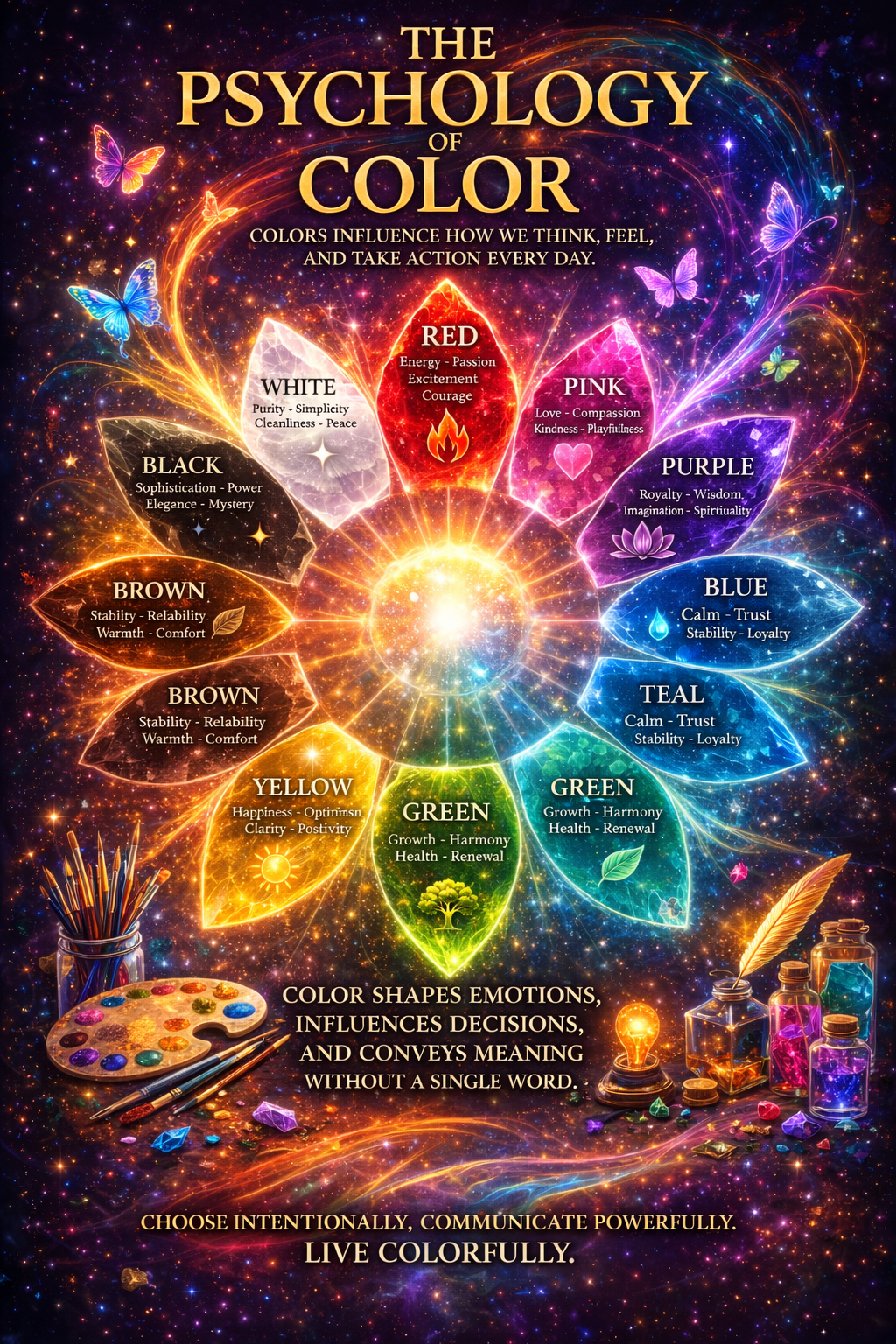
Color is a language the mind understands before the eyes do. Blue slows the breath, green restores a sense of balance, and warm golden tones stimulate feelings of comfort and safety — all backed by decades of psychological research. When we become intentional about the colors we surround ourselves with, we quietly begin to shape the emotional landscape of our inner world. Color is not decoration. It is communication — between the world and the nervous system, between the environment and our emotional wellbeing.
The field of color psychology has roots stretching back further than most people realize. Early researchers in chromotherapy — color-based treatment — explored how different wavelengths of light affected mood, energy, and physical wellbeing. Traditional healing practices across many cultures noted the calming effect of certain environments and the energizing quality of others, observing that color played a meaningful role in how people felt. Even the great Swiss psychiatrist Carl Jung incorporated color analysis into his therapeutic work, believing that the colors a person was drawn to — or repelled by — revealed important information about their psychological state. The modern science of color psychology has built rigorously on these foundations.
Research has given us specific and fascinating insights into how individual colors affect us. Blue — the color of open sky and deep water — activates the parasympathetic nervous system, slowing heart rate and reducing blood pressure. It promotes feelings of calm, trust, and expansiveness, which is why it appears so frequently in therapeutic and medical environments. Green, the color most associated with nature, triggers what researchers call the restorative response — a measurable reduction in stress and an increase in feelings of equilibrium and renewal. Yellow stimulates serotonin production, lifting mood and sharpening mental clarity. Red increases adrenaline, creating urgency, passion, and heightened alertness.
In the practice of art therapy, a person's color choices are never considered arbitrary. The colors we reach for instinctively — and those we avoid — carry psychological information that words may not yet have found a way to express. A person moving through grief may find themselves consistently choosing gray and muted tones. Someone in a period of creative breakthrough may be drawn suddenly to vibrant, clashing combinations they would normally never choose. These are not random aesthetic preferences. They are the psyche communicating through the only language available to it in that moment.
You do not need to be an artist to use color psychology in your daily life. Begin by noticing which colors you are instinctively drawn to today — and which ones feel uncomfortable or heavy. Pay attention to the colors in your home, your clothing, your workspace, and how they make you feel throughout the day. Experiment intentionally: add a green plant to a room that feels stressful. Wear yellow on a day when you need a lift. Paint a wall in a calming blue-gray. Use warm amber tones in the evening to help your nervous system wind down. Color is always speaking to you. Learning to listen — and to respond — is one of the gentlest and most accessible forms of self-care available.
Self-Compassion & Inner Healing
It All Begins Here
The most radical act of healing is learning to treat yourself with the same gentleness you would offer a dear friend. Self-compassion, as pioneered by researcher Dr. Kristin Neff, is not self-indulgence — it is the foundation upon which lasting mental wellness is built. When we stop fighting ourselves and start holding ourselves with kindness, transformation becomes not just possible but inevitable. This is not a soft idea. It is one of the most rigorously supported findings in the modern science of psychological wellbeing.
Most of us were never taught to be kind to ourselves. We were taught to be productive, to meet standards, to improve, to strive. The inner voice that catalogues our failures, replays our most embarrassing moments, and reminds us of everything we have not yet become is, for many people, the most constant and familiar voice in their inner world. We would never speak to a child the way we speak to ourselves. We would never say to a grieving friend what we say to ourselves in the dark of 3 a.m. And yet we accept this relentless self-criticism as normal, as necessary, even as motivating. It is none of these things.
Dr. Kristin Neff's decades of research have established three core components of self-compassion, each essential to the whole. The first is self-kindness — choosing to treat ourselves with warmth and understanding when we suffer, fail, or fall short, rather than harsh judgment and cold indifference. The second is common humanity — recognizing that suffering, imperfection, and difficulty are not personal failures but universal features of the shared human experience. The third is mindfulness — holding our painful thoughts and feelings in balanced awareness, neither suppressing them nor amplifying them. Together, these three elements create a psychological foundation of safety that makes genuine growth possible.
The paradox of self-compassion is that it produces precisely the outcomes that self-criticism promises but never delivers. People who practice self-compassion are more resilient in the face of failure, not less. They are more motivated to learn from their mistakes, not less. They are more emotionally stable, more willing to take healthy risks, more authentic in their relationships, and more capable of genuine intimacy. This is because self-compassion creates the psychological safety needed for honest self-reflection. When we know we will meet our own imperfections with kindness, we stop needing to hide them — from ourselves or from others.
Beginning a self-compassion practice does not require a therapist or a course or a perfect set of conditions. It requires only the willingness to pause, in a moment of pain or difficulty, and to try something different. Place your hand over your heart. Feel its warmth. Take a breath. And say — silently or aloud — something simple: This is hard. I am struggling. This is a moment of suffering, and I am going to meet it with kindness. These words may seem small. But repeated over time, practiced in the small ordinary moments of daily life, they begin to rewire something deep in the nervous system. They teach the body that it is safe to be imperfect. And from that safety, genuine and lasting growth becomes possible.
Art Journaling for Mental Health
It All Begins Here
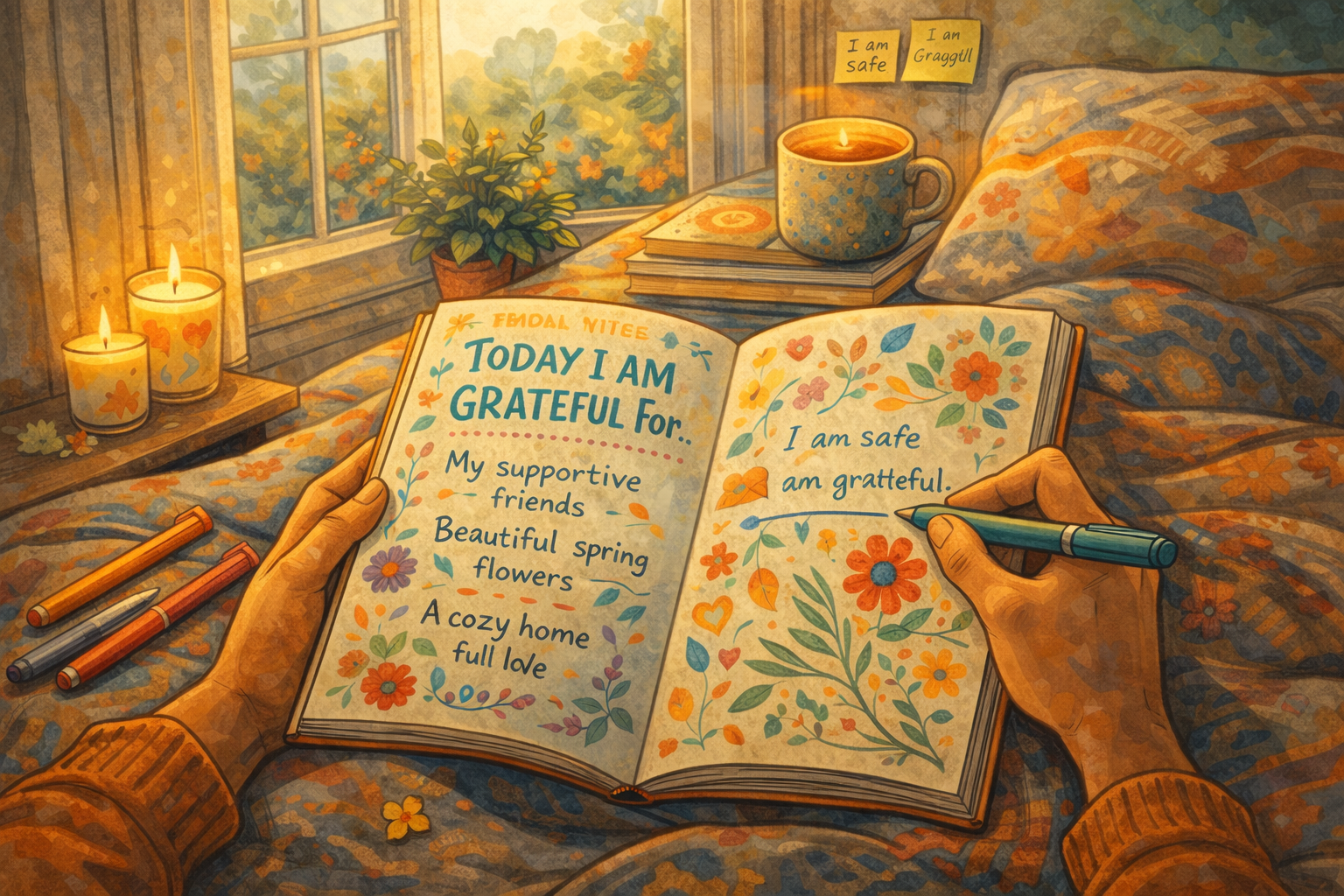
An art journal is not about perfection — it is about permission. Permission to feel, to express, to release whatever has been living silently beneath the surface. Research shows that combining visual art with reflective writing reduces cortisol levels, eases anxiety, and creates a profound sense of emotional clarity and calm. If you have ever felt like your emotions were too big, too complicated, or too messy to put into words, an art journal might be exactly what your healing has been waiting for.
The beauty of art journaling lies in its radical inclusivity. There are no prerequisites, no minimum skill level, no standard to meet. Your journal does not care whether you can draw a straight line or mix colors correctly. It asks only that you show up honestly and allow whatever is inside you to find its way onto the page. A splash of watercolor. A torn piece of magazine. A scribbled word. A page painted entirely black because that is what today feels like. All of it is valid. All of it is healing. All of it counts.
Psychologists have long understood that externalizing our internal experiences — giving them a physical form outside of ourselves — creates what is called emotional distance. This distance does not mean disconnection. It means perspective. When your anxiety exists only inside your chest, it fills every corner of you. When you put it on a page — as a color, a shape, a tangled mess of lines — it becomes something you can look at rather than something you are trapped inside. That shift from drowning in a feeling to observing it is one of the most powerful moves available to the human mind.
Art journaling also works because it engages both hemispheres of the brain simultaneously. Writing activates the analytical, language-based left hemisphere, while visual mark-making engages the intuitive, image-based right hemisphere. When these two systems work in concert, something remarkable happens: integration. The disconnected fragments of our emotional experience begin to cohere. Memories link to feelings. Feelings link to insight. Insight creates the possibility of change. This is not poetic metaphor — it is measurable neuroscience.
If you are new to art journaling, begin simply. Buy a journal with blank pages — any size, any price. Gather a few basic supplies: colored pencils, markers, watercolors, a glue stick for collage. Set aside ten minutes, two or three times a week. Open to a fresh page and ask yourself: how do I feel right now? Then respond — not with words alone, but with color, shape, and texture. Let the page hold what you cannot hold alone. Over time, you will not just fill pages. You will find yourself. And that discovery, made one honest mark at a time, is one of the most quietly transformative gifts you will ever give yourself.
The Healing Power of Art
It All Begins Here
Art is not merely something we create — it is something that creates us. When we pick up a brush, a pen, or a piece of clay, we give our inner world a voice that words alone cannot capture. Science confirms what artists have always known: the act of creating heals, restores, and quietly puts us back together. There is a profound shift that happens the moment we allow ourselves to make something — anything — with our hands and our hearts. We stop being passive observers of our own lives and become active participants in our own healing.
For centuries, long before psychology had a name or art therapy was a recognized field, human beings instinctively turned to creative expression during times of pain, grief, confusion, and transformation. Handwoven textiles, painted pottery, intricate carvings, and illustrated manuscripts — these were not merely decorations. They were acts of survival and communication. They were ways of saying: I was here. I felt this. I made something from the weight of my experience, and in doing so, I became more whole. That impulse lives in every one of us still.
Modern neuroscience is now beginning to confirm what researchers in art therapy and psychology have long observed. Creating art activates the brain's reward centers, releasing dopamine — the neurotransmitter associated with pleasure, motivation, and emotional regulation. It engages the prefrontal cortex, the seat of higher reasoning and emotional processing, while simultaneously calming the amygdala — the brain's alarm system. In other words, the act of creating art shifts our neurological state from one of threat and tension to one of safety and openness. It is, quite literally, medicine for the mind.
One of the most beautiful things about art as a healing practice is that it requires nothing of you except your willingness to begin. You do not need to be talented. You do not need formal training. You do not need expensive materials or a dedicated studio. You need only a surface, something to mark it with, and the quiet courage to show up and see what comes. The healing is not in the finished product — it is in the process. In the reaching, the choosing, the placing of one mark beside another. That is where the transformation begins.
Art heals because it gives form to the formless. Emotions that have no language, experiences that resist narrative, grief that defies explanation — all of these can be held and expressed in color, texture, shape, and line. When we create, we externalize our interior world. We make our inner life visible, and in doing so, we create a little bit of distance between ourselves and our pain. We become the artist observing the emotion, rather than the person drowning inside it. That shift — however small — changes everything. At Mind Tree, we believe that creativity is not a luxury. It is one of the most essential and accessible pathways to healing that any of us will ever find.